Teaching Between the Miles: How Rural Music Educators Are Rewriting the Rules of the Private Lesson
Drive thirty minutes in almost any direction from Huntingdon, Pennsylvania, and the landscape shifts fast. Farmland. Ridgelines. Small towns with one stoplight and a dollar store. It's beautiful country, and for a lot of families living in it, a quality music education for their kid is genuinely out of reach—not because they don't value it, but because the logistics don't work.
The nearest qualified guitar instructor might be 45 minutes away. That's 45 minutes each direction, twice a week if you want real progress, on top of whatever else a working family is managing. For a 30-minute lesson that costs $40, the math gets ugly fast.
Music teachers in rural central Pennsylvania know this math intimately. And a growing number of them are refusing to accept it as a fixed constraint. Instead, they're rebuilding the private lesson model from the ground up—mixing online instruction with in-person sessions, creating group formats that make lessons more affordable without gutting their own income, and forging partnerships with schools, libraries, and community organizations to reach students who'd otherwise fall through the cracks.
The Old Model Wasn't Built for This
The traditional private lesson structure—one teacher, one student, one hour, one price—was designed for a different world. It assumes geographic density. It assumes families with reliable transportation and flexible schedules. It assumes a student population concentrated enough that a teacher can fill a full week's worth of slots without anyone driving unreasonable distances.
In rural areas, none of those assumptions hold.
Sarah Kimmel has been teaching piano and voice in Mifflin County for eleven years. When she started, she ran a conventional studio: 25 students, weekly in-person lessons, a recital in the spring. Then gas prices spiked, a couple of families moved, a school district cut its music program, and the ripple effects hit her enrollment hard.
"I lost seven students in one semester," she says. "Not because they didn't want lessons. Because things got complicated for their families and the lesson was the thing that got cut. I started thinking, what would have to change for that not to happen?"
What changed, over the next two years, was almost everything about how she runs her studio.
The Hybrid Pivot
Online music instruction got a reputation boost it probably didn't expect from the pandemic. Before 2020, most teachers viewed video lessons as a compromise—fine for an emergency, not ideal as a steady diet. Then millions of teachers were forced to make it work, and many of them discovered that it worked better than expected, especially for certain instruments and certain students.
For rural educators, the implications were significant. A teacher in Huntingdon County can now maintain students in communities they could never have served in person. A family in a hollow without easy highway access can get consistent, quality instruction without the weekly trek.
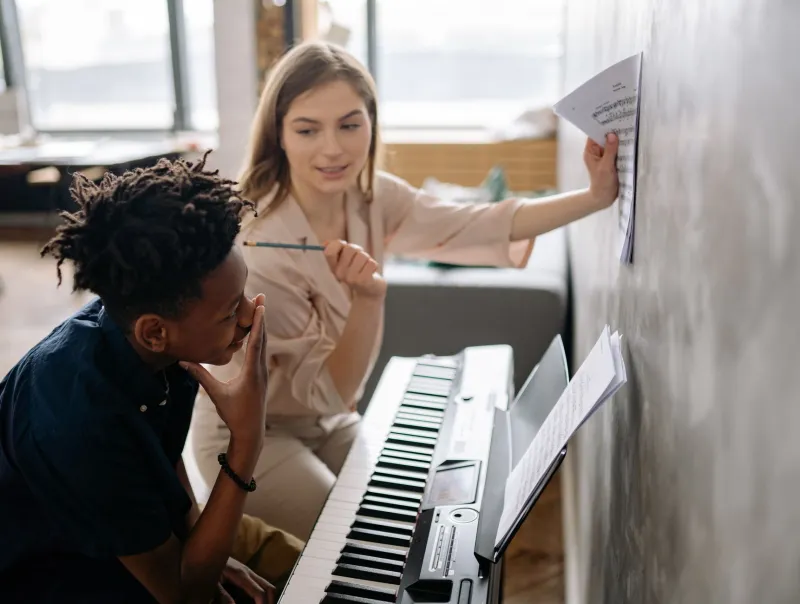
Kimmel now runs roughly 40 percent of her lessons online. She's developed a clear system for which students and which lesson types work best in each format—ear training and theory exercises translate well to video; early technique work on piano is harder to monitor remotely, so she front-loads in-person sessions for new students and shifts to hybrid once they've built foundational habits.
"It took me a while to stop feeling like the online lessons were lesser," she admits. "Now I think of them as a different tool. Some things you do in person. Some things work great on a screen. The mix is what makes the whole thing sustainable."
Group Lessons as an Economic Engine
Another shift happening quietly across the region: the rehabilitation of the group lesson.
For decades, private music instruction was synonymous with one-on-one teaching. Group lessons were seen as a budget option, a compromise for families who couldn't afford the real thing. That framing is changing, partly out of necessity and partly because teachers are discovering that group instruction has genuine pedagogical advantages that the private lesson model undersells.
Dave Reisinger teaches guitar and bass in rural Perry County. Three years ago, facing declining enrollment and rising costs, he started experimenting with small-group formats—two or three students at similar skill levels sharing a 60-minute session.
"The first thing I noticed was that they learned from each other in ways I couldn't manufacture one-on-one," he says. "When one kid is struggling with a chord transition and another one figures out a trick for it and explains it to them—that's a teaching moment I didn't plan and couldn't have scripted."
The economics work differently too. A 60-minute session with three students at a reduced per-student rate still generates more revenue per hour than a single private lesson, while making instruction more affordable for each family. Reisinger has structured some of his group offerings as a co-op, where families pay a semester rate upfront in exchange for a modest discount—giving him predictable income and giving them a reason to stay committed through the full term.
Community Partnerships That Fill the Gaps
Some of the most creative solutions involve stepping outside the traditional studio model entirely.
A few music educators in the region have established informal partnerships with public libraries, which increasingly view music programming as part of their community mission. A teacher who runs a monthly group workshop at a local branch library reaches families who would never seek out a private studio—and the library gets programming it couldn't otherwise offer. Nobody's getting rich from these arrangements, but they expand the footprint of music education in communities where it's scarce.
School partnerships are trickier, given budget constraints and liability concerns, but some teachers have found workable arrangements—running after-school programs, offering instrument instruction that complements (rather than competes with) the school's existing offerings, or connecting with band directors who refer students needing additional support.
Juniata College has played a role in this ecosystem too, through outreach programs and student-teacher practicums that place music education students in community settings. Those connections don't always persist after graduation, but they create relationships and awareness that sometimes lead to longer-term collaboration.
Pricing Without Undercutting Yourself
One of the hardest conversations in rural music education is about money. Teachers who serve lower-income communities often feel pressure to price their services below what's sustainable—and then burn out or leave the field, which doesn't serve anyone.
Sliding-scale pricing, done thoughtfully, can help. Several teachers in the region have developed tiered structures that allow families who can pay full rate to do so, while creating genuine access for those who can't—without making the process humiliating or bureaucratic. The key, most of them emphasize, is keeping it simple and treating it as a normal part of the conversation rather than a special exception.
"I just tell new families upfront that I have a range and we figure out together where they land," says Kimmel. "It's not a big deal. Most people are honest about what they can do, and the ones who can pay full rate usually do."
A Model Worth Watching
What's emerging in central Pennsylvania isn't a single solution—it's a toolkit. Hybrid delivery, group formats, community partnerships, flexible pricing, and a willingness to question the assumptions baked into the traditional private lesson model. None of these ideas are entirely new, but the combination of them, adapted to the specific geography and economics of rural America, is producing something worth paying attention to.
For music educators anywhere who are watching their enrollment plateau or wondering how to build a practice that actually lasts, the rural teachers of this region have some hard-won answers. They didn't get there by following a playbook. They got there by being willing to write a new one.