Notes in the Margins: How Musical Training Quietly Supercharges Careers Outside the Industry
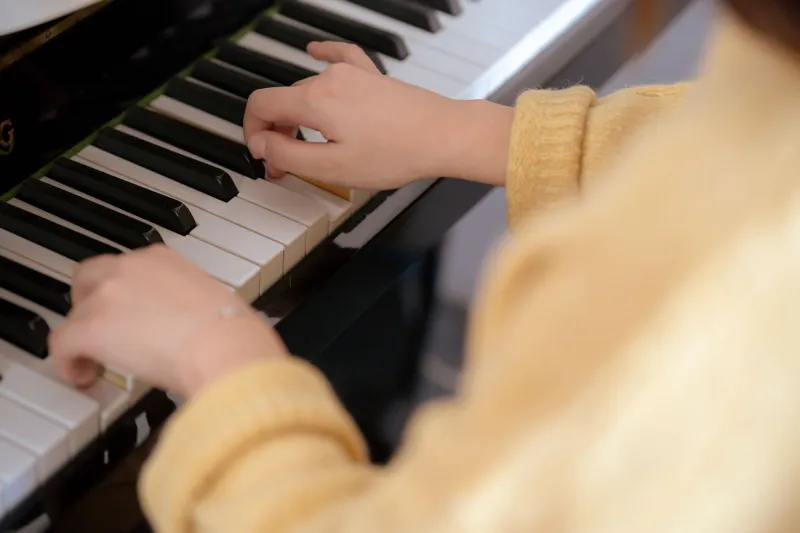
Nadia Osei-Bonsu spent four years at Juniata College playing piano in the jazz ensemble, performing in chamber groups, and logging more practice room hours than she cares to remember. She graduated in 2011 with a degree in biochemistry and a minor in music, fully expecting that the music part of her college experience would become a pleasant footnote.
Today she's a clinical pharmacist at a hospital system in Pittsburgh. And she'll tell anyone who asks that playing piano made her better at her job in ways she never anticipated.
"In jazz, you're constantly listening and responding," she explains. "You're reading the room, adjusting in real time, anticipating what your bandmates are about to do. That's exactly what happens in a patient care team meeting. You're not just delivering information — you're listening for what people aren't saying, adjusting your communication style, reading the dynamics of the room. I genuinely believe jazz taught me how to do that."
Nadia's story isn't unique. Across the Juniata alumni network and the broader regional music community, a pattern keeps emerging: the people who spent years making music often bring something extra to their non-music careers — something they can feel but sometimes struggle to articulate until someone asks the right question.
The Discipline Nobody Talks About
When people think about musical skills, they usually land on the obvious ones: reading notation, keeping rhythm, understanding theory. What gets talked about less is the kind of discipline that music builds over years of practice — the specific, granular experience of breaking a complex task into small components, working each one patiently, and then reassembling the whole.
That process maps onto almost any professional challenge you can name.
Dave Przybylski, a Juniata alum from the class of 2006 who played trombone through all four years and is now a project manager at a civil engineering firm in Harrisburg, describes it as "chunk thinking."
"When you're learning a difficult passage, you don't just play it from the beginning over and over hoping it gets better," he says. "You isolate the hard measure. You slow it way down. You fix the specific problem. Then you zoom back out. I do exactly that with project timelines now. When something's going wrong, I resist the urge to restart everything from scratch. I find the specific problem and fix it. That's a music brain thing."
His colleagues don't know where the habit comes from. They just know he's good at untangling complicated situations without panicking.
Performing Under Pressure
Here's something every musician knows and almost nobody outside of music fully appreciates: performing in front of people is genuinely hard, and doing it repeatedly builds a specific kind of psychological resilience that's difficult to develop any other way.
You prepare, you walk out in front of an audience, and then — no matter what happens — you keep going. A memory slip, a wrong note, a reed that suddenly decides to misbehave: you adapt and continue. You don't get to stop and start over. The show goes on.
That experience accumulates into something real.
Amy Brubaker played violin in the Juniata Orchestra before graduating in 2009 and eventually earning a law degree. She's now a litigator at a firm in Philadelphia, and she points to her performance background as the single most useful preparation she had for courtroom work.
"Law school teaches you the law. It does not teach you how to stand in front of a judge and opposing counsel and a room full of people and think clearly when something unexpected happens," she says. "Music taught me that. I've had witnesses say something completely off-script in the middle of a trial. I didn't freeze. I just... adapted. Because I've been adapting in real time since I was sixteen years old."
She pauses. "Also, concert black is basically a suit. The transition wasn't that hard."
Collaboration as a Competitive Edge
One of the things that makes ensemble music different from, say, competitive sports is the nature of the collaboration required. In an orchestra or a chamber group, you're not just cooperating — you're listening at a level of granular attention that most group activities never demand. You're adjusting your volume, your timing, your tone, in response to what everyone else is doing, simultaneously, in real time.
That's a genuinely unusual skill. And it turns out to be extraordinarily useful in team-based professional environments.
Trevor Mast, who played guitar in several bands during his time near Huntingdon and now works as a software engineer at a tech company in Pittsburgh, says ensemble experience changed how he thinks about team communication entirely.
"In a band, you learn really fast that everyone's part matters and that the whole thing falls apart if someone's not listening," he says. "I bring that into code reviews, into sprint planning, into any team meeting. I'm genuinely interested in what everyone else is doing and how it connects to my piece. A lot of engineers aren't naturally like that. They're focused on their own work. I think music made me different."
His manager, he mentions with some amusement, has described him as "unusually good at not being precious about his own work" — meaning he's willing to revise, adapt, and integrate feedback without getting defensive. Trevor credits years of being told by bandmates that something wasn't working and having to figure out a solution on the fly.
Pattern Recognition and Creative Problem-Solving
Music theory, at its core, is the study of patterns. Chord progressions, rhythmic structures, melodic development — these are all systems with rules, exceptions, and infinite variations. Learning to hear and understand those patterns trains the brain in ways that show up in surprising places.
Nadia, the clinical pharmacist, talks about this in terms of diagnostic thinking.
"When I'm looking at a complex patient case, I'm looking for patterns. Which medications are interacting? What's the underlying cause of this symptom cluster? It's not that different from hearing a chord progression and knowing where it wants to go next. Your brain is trained to recognize structure and predict what comes next."
Dave the project manager echoes this in his own domain: "I can look at a project schedule and feel when something's off before I can articulate why. It's like hearing a wrong note. The pattern breaks, and your brain flags it immediately."
What This Means for Music Education
There's a bigger conversation embedded in all of this, and it's one worth having explicitly: the skills built through music education have value far beyond the music itself. That's not an argument against music as music — the intrinsic value of making art is real and doesn't need to be justified by career outcomes. But it is an argument for protecting and investing in music programs, even in communities where the economic case for arts education gets questioned.
Every person we talked to for this story mentioned, in some form, that they wished they'd understood sooner how much their musical training was shaping them. Not just what they played, but how they thought. How they listened. How they handled difficulty and uncertainty and the specific terror of performing in public.
Those things followed them out of the rehearsal hall and into every room they've walked into since.
As Nadia puts it: "I thought I was studying biochemistry with a music minor. Turns out I was also studying how to be a professional. Music was just the classroom."
For anyone who's ever wondered whether those years of lessons and rehearsals were worth it — even if the stage was left behind long ago — the answer, it seems, is a pretty definitive yes.